
Put a Whole Kindle BookInside a Claude Project
Capture the book from Kindle Cloud Reader, save the text as one file, and attach it where Claude keeps it: a Project for chat, or a Claude Code Skill for the terminal.
Local-First Processing
Works with Kindle Cloud Reader
No Desktop Software
Why Claude Cannot Open Your Kindle Book
Claude reads files you give it. A Kindle book is not a file you hold, and Kindle Cloud Reader limits how much text you can copy out of it.
Claude takes a plain text file, so the job is turning a Kindle book into one. TextMuncher captures the rendered pages in Kindle Cloud Reader and reads them with screenshot OCR, giving you a .txt file of the chapters you captured. From there it is a Claude decision, not a Kindle one: attach the file to a Claude Project and Claude draws on it in every conversation there, pulling in the relevant parts when the file is large, or drop it in your repo and have a Claude Code Skill load it on demand from the terminal. Anthropic publishes a 1M-token context window for Claude Opus 5 and Claude Sonnet 5 on paid plans.
There Is No File to Attach
Claude Projects and Claude Code both want a file. Kindle Cloud Reader renders pages in the browser and never hands you one.
Screenshots Fill the Context
Uploading page images to Claude costs several times the tokens of the same content as clean text, so far less of the book fits.
Retyping a Chapter Is a Lost Evening
Transcribing by hand is the only manual route, and nobody finishes a book that way.
What TextMuncher Gives a Claude User
One File, Not Forty Screenshots
Captured chapters come out as continuous plain text. Save it once and attach that single file to a Project.
Text Goes Further Than Images
Clean text costs several times fewer tokens than page images, so more of the book sits in context at once.
Capture Runs Itself
TextMuncher turns pages and captures screenshots hands-free. Check longer captures when they finish; if the run stopped early, restart from the last saved page.
How It Works
Three steps. No technical knowledge required.
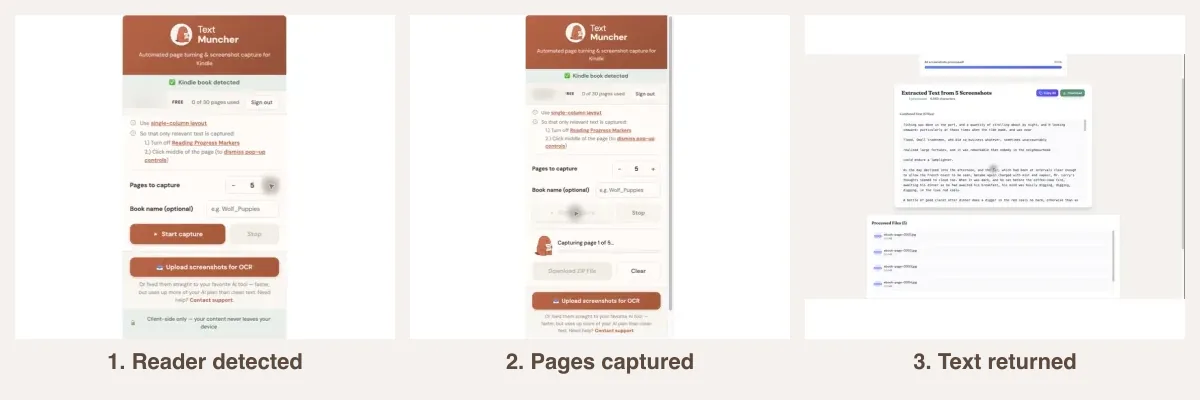
1. Capture the Book
Install TextMuncher, open the book in Kindle Cloud Reader, and start the capture. It turns pages and reads each one.
2. Save the Text as One File
Export the extracted chapters to a single .txt file and give it the book's title, so Claude has something to cite.
3. Attach It in Claude
In Claude.ai, add the file to a Project so every chat in it can read the book. In Claude Code, keep the file in your repo and reference it from a Skill so any terminal session can load it.
4. Ask in Book Terms
Point Claude at a chapter, ask it to trace an argument across the book, or have it draft a literature note with quotes pulled from the file.
the full Kindle to Claude workflow guide why text beats screenshots for AI analysis
Related Resources
Kindle to ChatGPT Kindle Course Reading Guide eBook to AI Summary Feed Books to AIFrequently Asked Questions
Claude Project or Claude Code Skill — which should I use?
Use a Project when you want to chat about the book: attach the file once and every conversation in that Project can see it, which suits reading notes, study questions, and drafting. Use a Claude Code Skill when the book is reference material for work you do in a terminal — keep the text file in the repo and let the Skill pull it in only when a session needs it, so it is not sitting in context the rest of the time.
How much of a Kindle book fits in one Claude conversation?
Anthropic states that Claude Opus 5 and Claude Sonnet 5 support a 1M-token context window on all paid plans when chatting with Claude, and lists the older models at 500K or 200K. Anthropic does not publish a words figure, but its glossary says a token is about 3.5 English characters, which works out to several hundred thousand words for a 1M-token window, so a full-length non-fiction book usually sits inside one conversation with room to spare. Anthropic's published figures: context window sizes on paid Claude plans. And on tokens: Anthropic's glossary definition of a token.
Does Claude work better with text or with screenshots of pages?
Text, clearly. Clean text costs several times fewer tokens than the same pages as images, so more of the book fits, and Claude reads it directly instead of interpreting a picture of it. Keep the page images only for figures and diagrams the text layer cannot carry.
Can I upload an EPUB to Claude instead?
If you hold a DRM-free EPUB, yes — Claude.ai lists EPUB among the file types it accepts, alongside PDF, DOCX, TXT, HTML, RTF, ODT, CSV, JSON, and XLSX, at up to 500MB per file in chat and 30MB per file in a Project. It does not accept Kindle's own .azw, .kfx, or .mobi files. For a book that only exists in your Kindle library, capturing the rendered pages and reading them with OCR is the route to a file. Anthropic's upload limits: what you can upload to Claude.ai.
Will the file stay in the Project, or do I re-upload it each time?
A file attached to a Claude Project stays with the Project, so every new conversation you start there already has the book. That is the practical reason to prefer a Project over pasting chapters into a single chat: you set it up once and stop thinking about it.
How does this differ from doing it with ChatGPT?
The extraction half is identical — TextMuncher produces plain text either tool reads. The difference is where the book lives afterwards. Claude gives you a Project that carries the file across conversations and a Claude Code path that reaches it from a terminal; the equivalent on other assistants works differently. Pick on the workflow you already use, not on the extraction.
Is the extracted text accurate enough to quote in research?
It is clean enough for literature reviews, summaries, and analysis. For anything you will quote in a citation, spot-check the passage against the book — OCR of a rendered page can misread an unusual typeface or a hyphenated line break.
Ready to Put a Book in Your Claude Project?
Get TextMuncher Free30 free pages • No credit card • Cancel anytime