
Extract TextFrom Textbooks
Turn locked textbook pages into editable text for notes, studying, and AI prompts.
Local-First Processing
Works with Kindle Cloud Reader
No Desktop Software
Why Do PDF Textbooks Resist Copying?
Many textbook PDFs and online readers render pages as images or restrict selection.
PDF textbook to text extraction depends on whether the PDF has a selectable text layer. If it does, you can copy directly. If the pages are images, take screenshots of the pages you need and upload those images to the TextMuncher web app for OCR; direct PDF upload is not supported. For McGraw Hill, VitalSource, Pearson, and Cengage readers, take screenshots manually and upload those images for OCR. The extension does not automate those readers. This screenshot workflow produces editable text for study notes, quotes, summaries, and AI prompts.
Scanned Pages Are Images
Many textbook pages look like text but behave like pictures, so normal copy fails.
Readers Restrict Selection
Course platforms often block copying even when the text is readable on screen.
Manual Notes Take Too Long
Typing paragraphs from a textbook is slow and error-prone.
OCR for Textbook Workflows
Editable Study Text
Get paragraphs you can paste into notes, outlines, flashcards, or AI prompts.
Student Friendly
Extract assigned readings from textbook platforms without fighting copy restrictions.
No Upload Required
Process pages locally in the browser by default instead of sending textbook files to random converters. Optional Pro Quality mode sends hard-to-read pages for a cloud second pass.
How It Works
Three steps. No technical knowledge required.
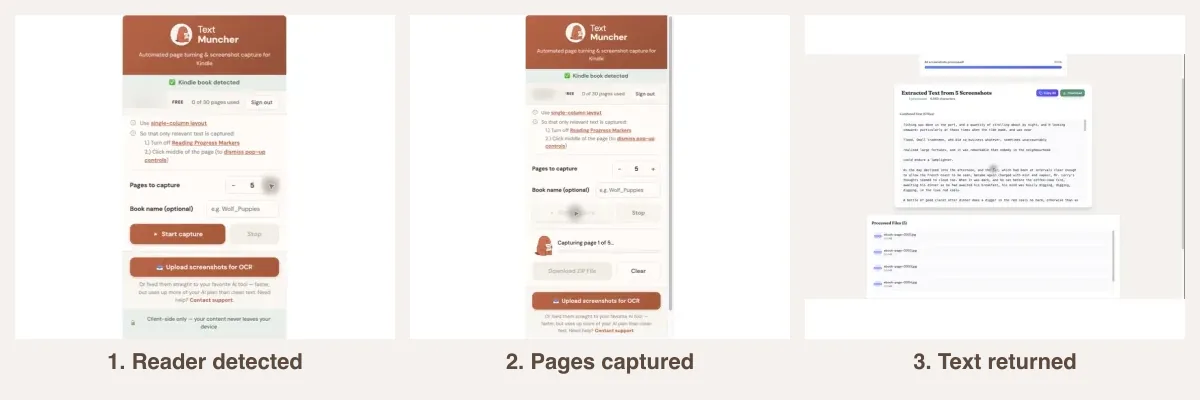
1. Open the Textbook Page
Use the browser reader or PDF view that shows the assigned content.
2. Upload Page Screenshots
Take screenshots manually in your textbook reader, then upload the images to the TextMuncher web app for OCR.
3. Use the Text
Paste into notes, Docs, Quizlet, ChatGPT, or your research workflow.
copy full chapters use text instead of screenshots
Related Resources
Scanned Book OCR Extract Ebook TablesFrequently Asked Questions
Does this work on scanned textbooks?
Yes, if the scanned pages are visible in the browser. OCR reads the image and returns editable text.
Can I extract an entire textbook?
Technically you can process many pages, but most users extract assigned chapters or sections. Keep copyright and school policy in mind.
Will equations and diagrams extract correctly?
Plain text works best. Equations, diagrams, and dense tables may need manual review or a separate visual workflow.
Is this only for Kindle?
No. TextMuncher is built around browser-visible pages, so it can help with web textbook readers and other page-based reading platforms.
Can I upload a PDF file directly instead of taking screenshots?
No. Direct PDF upload is not supported. Take screenshots of the PDF pages or export them as images, then upload those images to textmuncher.com for OCR. For a locked online reader, take screenshots manually. Standard OCR processes the images locally in your browser; optional Pro Quality mode sends hard-to-read pages for a cloud second pass.
How do I tell whether my PDF already has selectable text?
Open it and try to highlight a word with your cursor. If the text highlights and copies normally, the PDF has a real text layer and you may not need OCR at all. If your cursor just draws a box over the page and nothing selects, the page is an image, which is exactly the case OCR is built to solve.
What about a textbook locked inside a course reader like VitalSource or Pearson?
Those platforms usually block downloads and copying, so there is no PDF to grab. The workaround is to screenshot the pages you are assigned while they are on screen, then upload those images to textmuncher.com for OCR. It is a manual capture rather than a hands-free one, but it turns otherwise locked reading into editable text.
Is it okay to extract text from my assigned textbook?
For your own studying, note-taking, and AI-assisted review, extracting the passages you are already assigned is a normal personal-use workflow. What you should not do is redistribute the text or share extracted chapters with others. Follow your school's policy and copyright rules, and treat the output as private study material rather than something to republish. Read our copyright and fair-use guide.
Will headers, footers, and page numbers show up in the text?
OCR captures everything printed on the page, so running headers, footers, and page numbers do come through mixed into the flow. That is easy to clean up, and for citation work the page numbers are actually handy to keep. If you want pure body text, a quick find-and-replace or manual trim removes the repeating header lines.
Ready to Extract Textbook Text?
Get TextMuncher Free30 free pages • No credit card • Cancel anytime