
Get Full Book TextInto Logseq
Extract complete chapters from Kindle and paste them into Logseq pages. Build a linked knowledge graph from your actual books.
Local-First Processing
Works with Kindle Cloud Reader
No Desktop Software
Why Logseq Users Struggle With Kindle
Logseq thrives on complete, linkable source material. Amazon's copy restrictions cut you off at the source.
TextMuncher extracts full chapter text from Kindle Cloud Reader so you can paste it into Logseq as block-level notes. Unlike highlight plugins that only sync My Clippings.txt fragments, TextMuncher captures every word on the page with high accuracy. Paste as a Logseq page, add [[page links]] and #tags, and let the graph build connections across everything you've read.
Amazon Blocks Full-Text Export
There's no official Kindle export that gives you full book text. Highlights-only tools miss the vast majority of your reading.
Highlight Plugins Are Fragment-Only
Logseq Kindle plugins import your clippings - isolated passages with no surrounding context to link from.
Open-Source Workarounds Don't Work
Calibre-based DRM removal works on encrypted files and can break with Amazon's updates.
Complete Book Content for Your Logseq Graph
Full Pages as Logseq Blocks
Paste complete chapters into Logseq. Split into blocks, add page links, and build a true knowledge graph.
Clean Plain Text Output
TextMuncher outputs clean text that pastes into any Logseq block without formatting noise.
Automated Extraction
The extension turns pages and captures screenshots hands-free. For longer ranges, review the saved pages and restart capture if the run ends early.
How It Works
Three steps. No technical knowledge required.
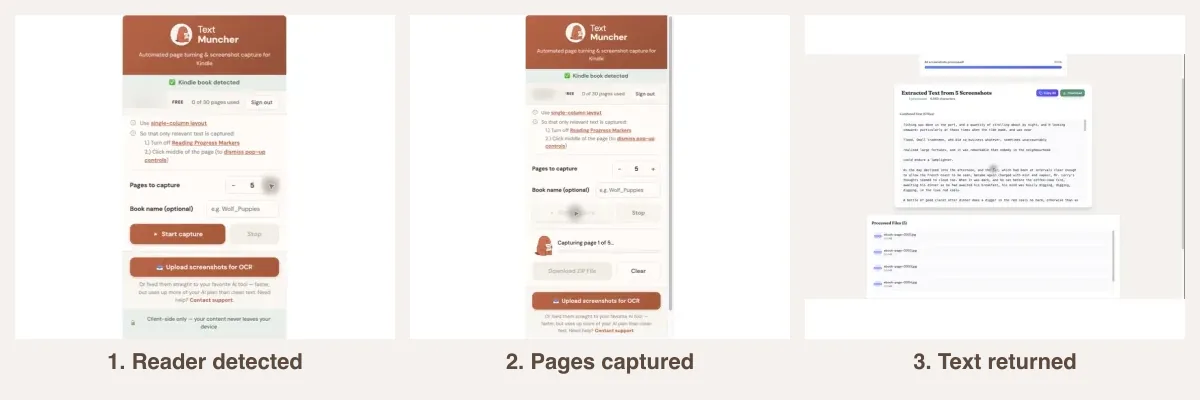
1. Install TextMuncher
Add to Chrome or another Chromium browser in 10 seconds.
2. Extract Your Chapter
Open the book in Kindle Cloud Reader and run TextMuncher to capture pages automatically.
3. Paste Into Logseq
Create a new page for the book or chapter, paste the text, and start linking.
why Kindle blocks text extraction using Kindle books with AI tools
Related Resources
Kindle to Obsidian Kindle to Roam Research Kindle to Bear Kindle to NotionFrequently Asked Questions
Does TextMuncher support Logseq's markdown format?
TextMuncher outputs plain text. Logseq uses its own block-based markdown. You'll add [[page links]], #tags, and block bullets yourself. Plain text pastes cleanly - no formatting noise to strip out.
How is this different from a Kindle highlights plugin for Logseq?
Highlight plugins pull from My Clippings.txt - only your highlighted passages. TextMuncher extracts full book pages, giving you complete source material. You can still choose which parts to link and annotate, but you're not limited to what you highlighted while reading.
Does this work with Logseq's local graph or the cloud version?
TextMuncher extracts text to your clipboard. You paste it into Logseq wherever your graph lives - local, cloud, or both. The extraction process is entirely browser-based and doesn't interact with your graph directly.
Can I use this for academic reading notes?
Yes. Many students and researchers use Logseq as a literature review tool. TextMuncher makes it possible to bring full book text into your graph alongside your papers and notes.
Is Logseq free? Do I need a paid plan?
Logseq is free and open-source. The local graph version is completely free. TextMuncher has a free tier of 30 pages, then $9.99/month for unlimited extraction.
Ready to Build Your Book Knowledge Graph in Logseq?
Get TextMuncher Free30 free pages • No credit card • Cancel anytime