Pull Passages FromAny Academic Ebook
Extract text from monographs, edited volumes, and university press ebooks for your literature review and dissertation chapters.
Local-First Processing
Works with Kindle Cloud Reader
No Desktop Software
Why Are Academic Ebooks So Restrictive?
You need a 200-word block quote with proper citation. The platform lets you copy 50 words. Now what?
TextMuncher extracts text from academic ebooks (Cambridge, Oxford, JSTOR, ProQuest, Project MUSE) so PhD researchers can build literature reviews, query AI tools on dense sources, and pull block quotes for dissertation chapters. The browser extension captures Kindle Cloud Reader pages automatically with high-accuracy OCR; screenshots from library ebook platforms can be uploaded to textmuncher.com for the same OCR. Cuts hours from monograph chapter work.
Academic Platforms Restrict Copy
JSTOR, ProQuest Ebook Central, and most university press readers cap or disable copy-paste. Block quotes become a manual transcription job.
Lit Reviews Take Months
Reading 80 monographs and 200 articles is the work. Retyping the passages you cite is overhead that adds nothing.
AI Can Compress Long Sources
Claude with 200K context can summarize a full monograph chapter, but only if you can actually paste it in.
How TextMuncher Helps Research Workflows
Block Quotes With Proper Context
Capture the full surrounding paragraph so you preserve the author's argument when you cite. Cleaner citations.
Query AI on Dense Material
Paste a full chapter into Claude or NotebookLM. Ask it to map the argument, find counterexamples, or check your reading.
Build a Searchable Corpus
Pipe extracted text into Obsidian, Zotero, or Roam. Your literature becomes searchable across years of reading.
How It Works
Three steps. No technical knowledge required.
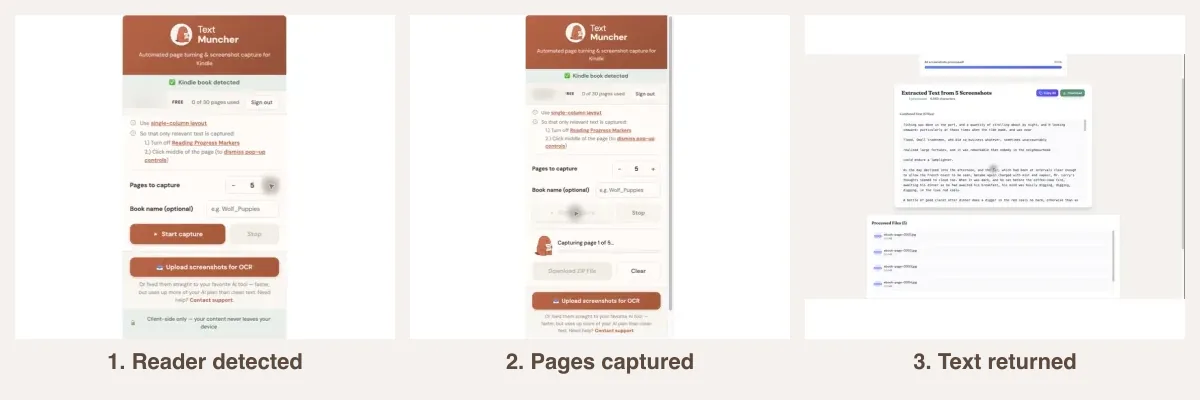
1. Install TextMuncher
Add to Chrome in 10 seconds. No account required.
2. Open Your Source
Kindle Cloud Reader gets automated capture. On VitalSource, ProQuest Ebook Central, JSTOR, Project MUSE, or other library platforms, screenshot the pages yourself.
3. Cite and Analyze
Drop extracted text into Zotero, Obsidian, NotebookLM, or your dissertation draft. Always verify quotes against the source.
using Kindle books with AI copy entire chapters from Kindle
Related Resources
For Thesis Writing Kindle to Zotero eBook Extraction Legal Guide For Medical Students For Law Students For ResearchersFrequently Asked Questions
Does TextMuncher work with ProQuest Ebook Central and JSTOR?
Not with automated capture - that is built for Kindle Cloud Reader. For ProQuest and JSTOR, screenshot the page view manually and upload the images to textmuncher.com for OCR. Verify accuracy on a few pages before processing a long section.
Will OCR introduce errors that show up in my dissertation?
Possible. Body text transcribes reliably. The discipline is the same as with any digital source: verify direct quotes against the original PDF or print version before submission. OCR speeds up reading and note-making, it doesn't replace proofing.
Can I use this with NotebookLM for my literature review?
Yes. Many researchers extract long monograph chapters with TextMuncher, then upload the text into NotebookLM as a source. NotebookLM's grounded answers work much better with full text than with summaries you typed yourself.
How does this compare to using a reference manager's built-in PDF tools?
Zotero and Mendeley work well when you have the PDF. TextMuncher fills the gap when you only have web access (a library ebook, a paywalled platform, a Kindle edition). Different tools for different sources.
Is extracting academic ebook text within fair use?
TextMuncher captures visible Kindle pages and turns the screenshots into text with OCR; it does not decrypt ebook files. Research is a purpose considered in US fair-use analysis, but academic use is not an automatic exemption. Whether your extraction or AI upload qualifies depends on the purpose, work, amount, market effect, and jurisdiction; not legal advice. Read our copyright and fair-use guide.
Ready to Speed Up Your Lit Review?
Get TextMuncher Free30 free pages • No credit card • Cancel anytime