
Export Kindle Vocabularyfor Language Learning
Pull vocabulary words with full sentence context from your Kindle books. Create flashcards and study lists from real reading material.
Local-First Processing
Works with Kindle Cloud Reader
No Desktop Software
Why Is Kindle Vocabulary Builder Limited?
Kindle tracks words you look up, but exporting them for real study requires more than what Amazon provides.
Kindle's Vocabulary Builder tracks words you look up while reading, but it only stores the single sentence of context and offers no export to flashcard apps. To get vocabulary words with full surrounding context, use TextMuncher to extract the complete text from pages where you encountered new words. Paste the text into Anki, Quizlet, or any language learning tool with the full paragraph around each word.
No Direct Export
Vocabulary Builder has no export button. Your word list is stuck inside the Kindle app with no way to get it into Anki or Quizlet.
Minimal Context
Vocabulary Builder saves only one sentence per word. For language learning, the full paragraph or page provides much better context for understanding usage.
Device-Locked Data
Vocabulary Builder data does not sync reliably across devices. Words you looked up on your Kindle may not appear on your phone app.
How to Get Full Vocabulary Context
Full Page Context
Extract the complete page text around vocabulary words. Full paragraphs help you understand word usage, connotation, and grammar patterns.
AI-Powered Flashcards
Paste extracted text into ChatGPT and ask it to create flashcards from unfamiliar words. Get definitions, example sentences, and translations automatically.
Eight OCR Languages
The OCR selector offers eight languages: English, German, Spanish, French, Italian, Portuguese, Dutch and Japanese. Extract vocabulary from foreign language books read on Kindle.
How It Works
Three steps. No technical knowledge required.
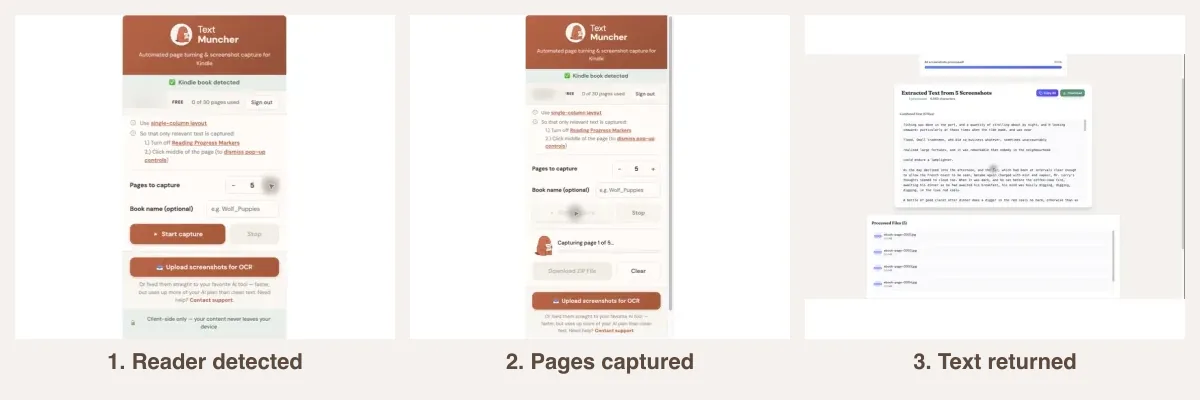
1. Identify Target Pages
Note which pages or chapters contain the vocabulary you want to study. Go there in Kindle Cloud Reader.
2. Capture Those Pages
Run TextMuncher to capture screenshots of the relevant pages. Capture as many as you need.
3. Create Study Materials
Upload for OCR, then paste the text into ChatGPT to generate flashcards, or directly into Anki or Quizlet.
using AI tools with Kindle books
Related Resources
Kindle to Anki eBook Highlights to Flashcards Get Books into AI Translation GuideFrequently Asked Questions
Can I access Vocabulary Builder data without TextMuncher?
On Kindle e-readers, the vocab.db file can be accessed by connecting via USB. This is a SQLite database that some tools can read. However, it only contains the looked-up word and one sentence of context, not full page text.
Does OCR work on foreign language text?
Yes, TextMuncher's OCR supports English, German, Spanish, French, Italian, Portuguese, Dutch and Japanese, but not vertical-text Japanese books. Accuracy is highest on standard printed fonts.
Can I use this with Anki?
Yes. Extract the text, then either manually create Anki cards or use ChatGPT to generate a CSV file you can import into Anki. Each card can include the word, definition, and a sentence from the book.
What about books in multiple languages?
TextMuncher's OCR reads one language at a time, chosen from a selector with 8 languages: English, German, Spanish, French, Italian, Portuguese, Dutch and Japanese (vertical-text Japanese is not supported). For a bilingual edition, pick the language most of the text is in, since text in another language, especially one written in a different script, may not come out cleanly.
Ready to Build Your Vocabulary?
Get TextMuncher Free30 free pages • No credit card • Cancel anytime