
Copy Quotes from Kindle for Paper: Cite It Right (2026)
Need to copy quotes from Kindle for paper? Extract any passage past the copy limit with OCR, then cite it in APA, MLA, or Chicago. 30 free pages.
• By Mike
To copy quotes from Kindle for paper, open the passage in Kindle Cloud Reader, capture the page as a screenshot, run OCR, proofread the line against the screen, then cite it with a stable locator such as page, chapter, section, or paragraph. This works even when Kindle blocks normal copy and paste.
The quote itself is never the hard part. The wall hits the moment Kindle says, "You have reached the publisher's copy limit set for this title," while your draft is open and your argument needs the next passage. I built TextMuncher because that wall kept turning normal research work into manual screenshot, retype, and citation cleanup.
Why Kindle Copy Stops in the Middle of a Paper
Kindle copy usually stops because the publisher set a per-title clipping cap, often around 5 to 10 percent of the book. Once you hit it, the normal Copy path can fail across Cloud Reader, desktop apps, and Notebook export. That is why paper writing breaks mid-source instead of at the start.
This is worse for researchers than casual readers. You may need to collect thirty passages from a 400-page monograph to end up using five sentences. The cap stops your writing in its tracks. It hits mid-source, at the moment you are already working.
The usual free path is to export your Kindle highlights from Amazon Notebook. Try that first if the quote is already highlighted and export still works. In late 2025, though, Notebook copying tightened on some titles, and it still respects the same publisher cap. It is a highlights archive, not a way past the wall.
The old Calibre plus DeDRM answer is also a bad bet for current purchases. Amazon removed the Download & Transfer via USB path in February 2025, and newer Kindle files are much harder to convert. If your paper is due soon, do not spend the night debugging a DRM toolchain. Capture the visible passage instead.
How to Extract the Quote After the Limit
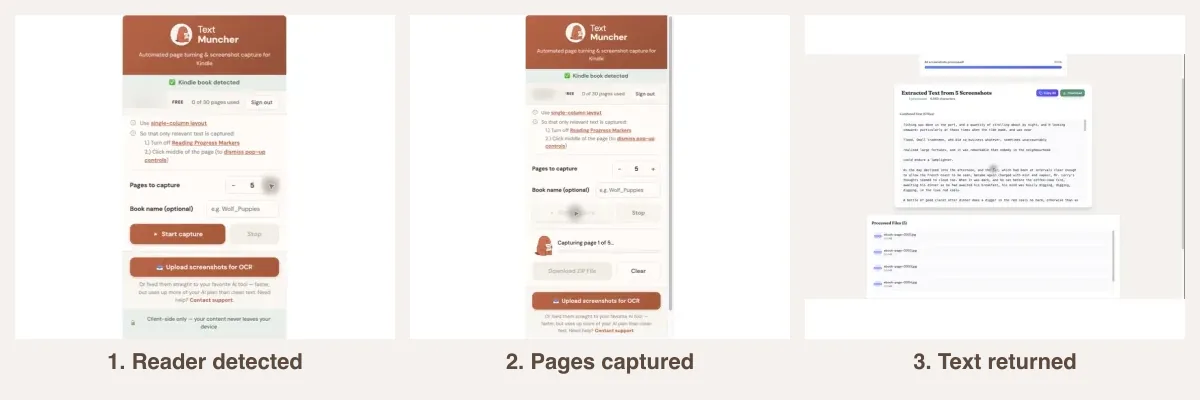
The reliable fallback is screenshot to OCR: capture the Kindle page you can legally view, convert the image to text, then paste only the needed passage into your notes. TextMuncher automates that capture and OCR loop for Kindle Cloud Reader, so the copy cap no longer controls your quote bank.
For one passage, the manual version is fine:
- Open the quote in Kindle Cloud Reader.
- Take a screenshot of the page.
- Run the screenshot through OCR.
- Paste the extracted line into your draft notes.
- Compare the line against the Kindle screen before citing it.
For a chapter, manual screenshots get tedious fast. That is the job TextMuncher was built for: the browser extension captures pages hands-free, then the web app turns those screenshots into copyable text. You can try TextMuncher free with 30 pages and no signup, which is enough for a targeted quote pull from one or two chapters.
The mechanism matters legally and technically. TextMuncher captures rendered pixels from your own screen and runs OCR. It does not decrypt Kindle files, remove DRM, call Amazon APIs, or alter the book. The output is text you still need to use narrowly: pull the quotations needed for scholarship, keep them private, and do not redistribute the book.
How to Cite the Kindle Quote Without Page Numbers
For a direct quote, cite the print-equivalent page number if Kindle shows one. If it does not, use a stable locator: chapter, section heading, paragraph number, table, or another marker a reader can find. Do not use Kindle location numbers as your main citation locator.
That rule is not TextMuncher-specific. Purdue OWL's APA guidance says direct quotes from sources without pages should use a logical locator such as paragraph or chapter. Purdue OWL's MLA FAQ says to avoid device-specific numbering systems. Purdue OWL's Chicago guidance allows chapter, section, or another clear locator when stable page numbers are missing.
Here is a clean worked example. Suppose TextMuncher extracts this sentence from a sample Kindle monograph:
"The archive rewards the questions it was built to answer."
You note the book details, the chapter, and the paragraph count from the start of that chapter:
| Field | Example |
|---|---|
| Author | Lena Rivera |
| Year | 2024 |
| Title | Reading the Civic Archive |
| Publisher | University Press |
| Publication city | Chicago |
| Locator | Chapter 3, paragraph 14 |
Then format it this way:
| Style | In-text or note | Reference entry |
|---|---|---|
| APA 7 | "The archive rewards the questions it was built to answer" (Rivera, 2024, Chapter 3, para. 14). | Rivera, L. (2024). Reading the civic archive. University Press. |
| MLA 9 | "The archive rewards the questions it was built to answer" (Rivera, ch. 3). | Rivera, Lena. Reading the Civic Archive. Kindle ed., University Press, 2024. |
| Chicago note | 1. Lena Rivera, Reading the Civic Archive (Chicago: University Press, 2024), chap. 3, para. 14, Kindle. | Rivera, Lena. Reading the Civic Archive. Chicago: University Press, 2024. Kindle. |
If Kindle displays real page numbers tied to a print edition, use those instead. If your journal, professor, or style sheet requires page numbers and Kindle does not show them, search the quote in Google Books or the publisher preview to recover the print page. If you cannot recover it, cite the chapter or section honestly rather than inventing a page. For MLA, use paragraph numbers only when the edition itself numbers them.
How to Move the Quote Into Zotero or Notion
After OCR, treat the quote as a research note with three parts: exact wording, locator, and source metadata. In Zotero, attach it as a child note under the book item. In Notion, keep the same fields in a database row so the citation survives the move into your paper.
My Zotero pattern is simple:
- Add the book to Zotero by ISBN, DOI, title search, or manual entry.
- Create a child note named
Quote bank. - Paste each extracted quote under a short topic label.
- Add
Locator: Chapter 3, paragraph 14or the exact page. - Add
Checked against source: yesafter proofreading.
That last line looks fussy until you are editing at 1 a.m. A direct quotation with one OCR error is still a misquote. Watch for l, I, and 1; 0 and O; italicized proper nouns; hyphenated line breaks; and any punctuation that changed at a page break.
If Zotero is your main stack, the send Kindle quotes to Zotero page covers the product workflow. If your reading log lives elsewhere, you can save Kindle quotes to Notion with the same quote, locator, source, and proofread fields. The exact app matters less than keeping the locator attached to the quote from the start.
How to Pull Many Quotes for a Lit Review
For a lit review, do not extract random pages. Build a quote bank by chapter, keep each passage paired with its locator, and separate exact quotations from paraphrase notes. This keeps the workflow fast without turning your source file into a messy block of uncited book text.
A good pass looks like this:
| Column | What to store |
|---|---|
| Claim | The argument the quote supports |
| Exact quote | The OCR text after proofreading |
| Locator | Page, chapter plus paragraph, or section |
| Source | Zotero item key, title, and author |
| Use | Epigraph, block quote, support, contrast, or maybe |
This is where screenshot OCR beats the one-at-a-time copy workaround. You can extract the chapter sections that matter, then work from the cleaned text while your argument takes shape. If you are synthesizing sources, the next step is to run a literature review on your Kindle books after the quotes are captured and checked.
The existing cap-hit guide still matters too. If you are trying to understand when Kindle says you've hit the copy limit, read that hub first. This post is the academic spoke: quote extraction, citation locator, reference manager, and paper workflow.
Legal and Proofreading Checks
The safe framing is narrow: quote material you bought or can legally access, for academic writing, using screenshots and OCR of pages shown on your own screen. That is not DRM circumvention. It is also not permission to extract and share whole books, upload licensed chapters publicly, or dodge your institution's rules.
Use less than you think you need. A paper quote bank should hold the passages you may cite, not a shadow copy of the book. Fair use depends on purpose, amount, market effect, and the nature of the work. Academic quotation is a strong purpose. Bulk redistribution is a different problem.
Before the quote enters your paper, run this check:
- Match the extracted text against the Kindle screen.
- Confirm the quote starts and ends exactly where your sentence says it does.
- Record the page number if Kindle shows one.
- If there is no page, record chapter plus paragraph or section.
- Put the locator into Zotero, Notion, or your draft note immediately.
That is the whole workflow: screenshot, OCR, proofread, cite, store. It is not glamorous, but it turns the Kindle copy-limit wall back into a normal research task.
FAQ
Use these answers when you need the short version: capture the Kindle page, OCR it, proofread the quote, and cite a stable locator. The FAQ keeps the citation details separate from the longer workflow above, so you can check the rule while drafting.
How do I copy a quote from a Kindle book to use in a paper?
Open the passage in Kindle Cloud Reader, screenshot the page, run OCR, proofread the extracted sentence against the screen, and cite it with a page number or stable locator. TextMuncher automates the screenshot and OCR step, so it still works after Kindle blocks normal copy and paste.
Can you copy and paste from Kindle Cloud Reader?
Sometimes. Kindle Cloud Reader may let you select and copy short passages until you hit the publisher's copy cap. After that, the Copy option can fail for the title. Screenshot plus OCR is the reliable fallback because it captures the page you can already see.
What do I do when Kindle says I have reached the copy limit?
Stop trying the same Copy button. The publisher cap is tied to the title, so switching surfaces usually will not fix it. Capture the rendered page, OCR it, proofread the text, then cite only the passages you need for your paper.
How do you cite a Kindle book with no page numbers in APA?
Use a stable locator such as chapter and paragraph: (Rivera, 2024, Chapter 3, para. 14). If Kindle shows a real print-equivalent page number, use that instead. Do not use Kindle location numbers as the main locator because they are device-specific.
Is it legal to copy Kindle quotes for a paper?
Quoting limited passages from material you legally bought or accessed for academic writing is standard scholarly practice. Screenshot plus OCR of your own screen is not DRM cracking. Keep the extracted text private, use only what your paper needs, and do not redistribute the book. Read our copyright and fair-use guide.
How do I get Kindle quotes into Zotero?
Create or import the book item in Zotero, add a child note, paste the proofread quote, and record the locator beside it. If the item has no page numbers, use chapter, section, or paragraph. TextMuncher gives you the copyable text; Zotero stores the source and citation.
The Kindle course-reading guide places this quote-checking workflow alongside discussion prep, study guides, flashcards, quizzes, and exam review.
Need searchable Kindle text for locating quotes? Try TextMuncher free: 30 pages included, no signup. Verify every quotation against the source.